A Thousand Sats in Days: Checking Your Rig Against 0.001 BTC
Small targets are the fastest way to test whether a rig performs as labelled. At today's pace, 250 TH/s banks about 0.00011215 BTC daily and clears 0.001 BTC in 8.9 days, while 2.5 PH/s does it in 0.9 days. The math rests on 1,003 EH/s of network hashrate and 450 BTC issued per day.
Key takeaways
- 0.001 BTC is a one-week yardstick: 8.9 days at 250 TH/s, 4.5 at 500 TH/s, 2.2 at 1 PH/s, 0.9 at 2.5 PH/s.
- Each TH/s averages 4.5e-07 BTC a day given 450 BTC spread over the network.
- Pool Hashrate shows live pool weight; Pool Luck frames why a given week lands above or below pace.
- Difficulty 132.76 T and the −2.12% retarget estimate set the backdrop for every short test.
Why a millibitcoin makes a good stopwatch
Waiting years to judge a machine is miserable. A 0.001 BTC marker solves that: at farm-scale rates it resolves inside a fortnight, sometimes inside a single day. Run the rig for a week, compare credited output against the expected slice, and you learn whether cooling, firmware, or a tired power supply is eating hashes. Think of it as a weigh-in rather than a life plan.
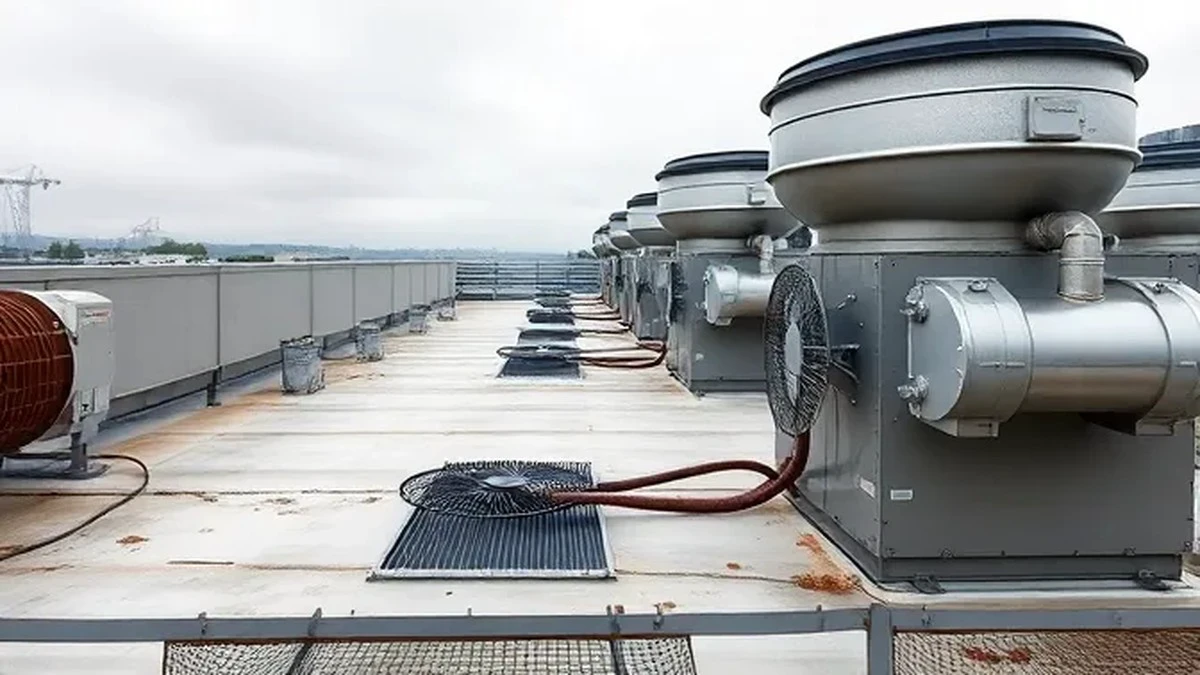
This piece follows a rooftop tinkerer, someone whose afternoons involve ducting, fan curves, and shade cloth. The question on the roof is always the same: did yesterday's airflow tweak move the needle? Only a short, fixed coin target answers that without drowning the signal in difficulty drift. Four hashrate rungs give the reference times; your payout log supplies the reality.
What the two pool dials add to a week-long test
Two figures on the pool board deserve a glance each morning. Pool Hashrate reports the pool's aggregate speed, which rarely explains your own shortfall but confirms the venue is healthy. Pool Luck compares recent blocks against expectation, and it matters more for weekly tests: a luck reading under 100% can leave even a perfect rig a touch short of its paper pace through no fault of the hardware.
That context is exactly what the ViaBTC Pool Hashrate view pairs with network difficulty and worker counts. Screenshot it when a test begins. If the week ends 5% light while luck printed 95%, the rig is likely fine; if luck printed 105% and you still trail, start checking fans, firmware, and rejected-share rates instead of blaming probability.
Four rungs, one short finish line
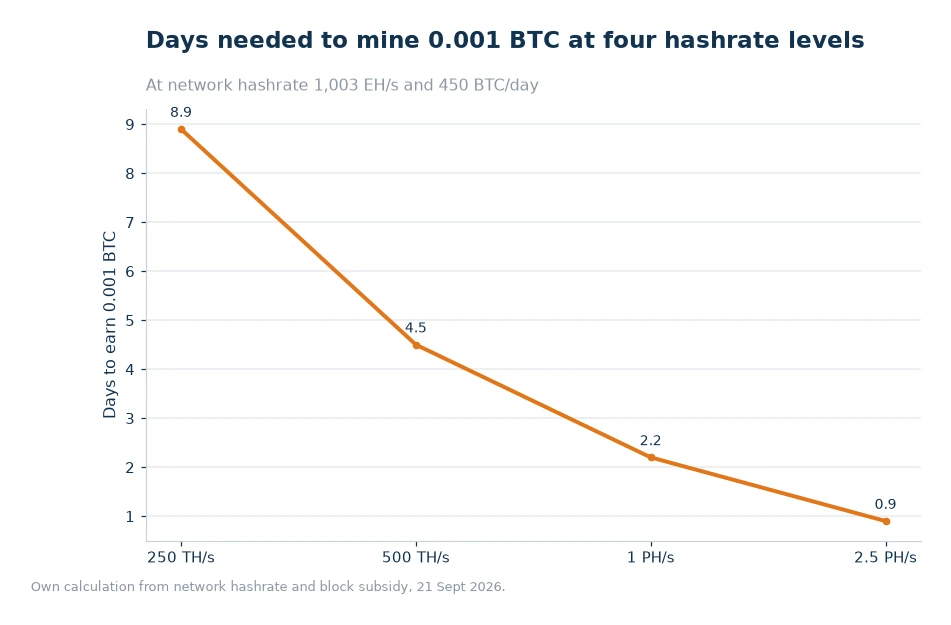
The chart compresses the whole experiment onto a single slope. A 250 TH/s shelf earns 0.00011215 BTC a day and crosses 0.001 BTC in 8.9 days. Double to 500 TH/s and the daily share becomes 0.00022432 BTC, good for 4.5 days. At 1 PH/s the day brings 0.00044865 BTC and the marker falls in 2.2 days, while 2.5 PH/s at 0.00112163 BTC a day finishes in 0.9 days. Twice the speed, half the wait, every step.
Valued at $84,692 per BTC, the prize is about $84.69, and daily accruals run from roughly $9.50 to $95.00 across the ladder. Those sums are small enough to treat as diagnostics rather than income. The Miner Profitability Ranking helps here: it lines up ASIC models by current price and difficulty, so a rig that trails its row can be flagged for cleaning or repair rather than excused.
Keeping the test fair across firmware and heat
Short tests punish inconsistency, which is their virtue. A rig that thermal-throttles each afternoon will underperform its nameplate even if midnight readings look perfect. Log credited output daily rather than trusting the miner's own display, since the pool pays for accepted shares under current difficulty, not for the number on the front panel. PPS+ smooths the series with hourly settlement of the reward slice; PPLNS answers after 6 confirmations and mirrors the last 5 difficulty rounds.
Hold conditions steady for the full run: same firmware, same fan profile, same clock. Note ambient highs alongside credited totals. If day three sags every time the roof hits peak sun, the fix is airflow, not a new pool. The ViaBTC App puts live hashrate and alerts on a phone, which beats climbing stairs to squint at LEDs when a unit drops a board mid-afternoon.
Fees enter, but they do not dominate a week
Listed rates still apply at small scale. PPS+, the default, carries a listed 4% on the PPS-settled block reward and a listed 2% on the fee component handled through PPLNS logic; PPLNS carries a listed 2% across both combined. Over 8.9 days those slices trim a few percent from gross, not a few multiples. For diagnostics that is noise, though for profit math it belongs in the sheet.
The subsidy behind every row is 3.125 BTC per block times 144 blocks, or 450 BTC a day network-wide, split by each miner's fraction of about 1,003 EH/s. Serve 150-plus countries and a million-plus users from one pool and the per-share slice still follows that fraction. Coin exits ride zero-fee mining payouts from the same account that holds the multi-currency wallet, so the test total arrives whole.
Turning the week's log into a maintenance ticket
A finished check should end with a decision, not just a number. If credited BTC trails the reference by under 3% while luck ran near par, write it off to variance and repeat the test next month. Between 3% and 8% short, open the machine's own log: look for a hot board, climbing rejected shares, or one hash chain reporting fewer chips than its siblings. Beyond 8%, stop testing and start servicing, because no difficulty quirk explains that gap at these short spans.
Keep a one-page record per rung: start and end dates, opening and closing credited totals, average ambient temperature, firmware version, and the pool's luck reading across the span. Three such pages reveal patterns a single week hides, like a unit that always sags in humid weather or after a particular firmware push. Support channels for mining guides respond far faster when the ticket arrives with those five lines attached instead of a vague complaint.
| Rung tested | BTC each day | Wait for 0.001 BTC | USD each day |
|---|---|---|---|
| 250 TH/s shelf | 0.00011215 | 8.9 days | $9.50 |
| 500 TH/s pair | 0.00022432 | 4.5 days | $19.00 |
| 1 PH/s rack | 0.00044865 | 2.2 days | $38.00 |
| 2.5 PH/s row | 0.00112163 | 0.9 days | $95.00 |
Worked example
Reproduce the bottom rung first. Network weight of 1,003 EH/s converts to 1,003,000,000 TH/s. Daily issuance is 450 BTC. Per-TH/s pace is 450 ÷ 1,003,000,000 = 0.00000044865 BTC, the 4.5e-07 rate in the chart note. A 250 TH/s shelf therefore earns 250 × 0.00000044865 = 0.00011216 BTC a day, shown as 0.00011215 BTC after rounding. Divide the marker: 0.001 ÷ 0.00011215 = 8.9 days.
The top rung scales directly: 2,500 TH/s earns 2,500 × 0.00000044865 = 0.00112163 BTC daily, and 0.001 ÷ 0.00112163 = 0.9 days. Between them, 500 TH/s at 0.00022433 BTC a day needs 4.5 days, and 1,000 TH/s at 0.00044865 BTC a day needs 2.2 days. All four quotients land on the plotted points, which is the check that the slope is honest division rather than marketing.
Frequently asked questions
How long should I run the 0.001 BTC check?
Run at least the full reference span for your rung, so 9 days at 250 TH/s or 5 at 500 TH/s, then compare credited BTC against 0.001 rather than judging by day two.
Why did my week land short if the rig ran nonstop?
Shortfalls usually trace to Pool Luck below 100%, a difficulty move, rejected shares from heat, or brief outages; compare the pool's luck reading and your accepted-share rate before assuming the chart is wrong.
Does settlement mode matter for a short test?
Somewhat: PPS+ settles hourly at current difficulty so the series looks even, while PPLNS follows 6 confirmations and the last 5 difficulty rounds, so luck swings show more clearly.
Weigh the rig, fix the duct, repeat
Close the week by writing three numbers in a notebook: expected BTC from the table, credited BTC from the log, and average Pool Luck across the run. If credited trails expected while luck ran hot, service the machine; if luck ran cold, extend the test a few days before touching hardware. Small markers, honestly measured, keep big machines honest.
Sources: ViaBTC pool state, miner ranking and app pages for readings and monitoring; chain inputs read 21 Sept 2026 (1,003 EH/s, 132.76 T, 450 BTC/day, BTC $84,692), published 24 Oct 2026[1].