Small-Batch Cosmetics Manufacturing: Planning a Low-Risk Pilot
A pilot batch is not a small version of a full launch; it is a test with a defined question. The manufacturer's own pages put the usual order minimum at 1,000–5,000 units per product and note a lower 500-unit entry that some suppliers offer to startups. Read against a 4–8 week ODM window, that first 500 units is cheap enough to run before the brand commits to the wider band.
Key takeaways
- Published order minimums are typically 1,000–5,000 units per product, with a 500-unit entry for startups.
- The ODM window is 4–8 weeks on an existing formula, so a pilot can reach testers before a full order is placed.
- Stability and compatibility reports take 3–6 months, longer than the pilot run itself, so start them early.
- A pilot earns its place by answering a question the brand cannot answer from a sample jar alone.
What a pilot is for
A pilot exists to answer one question before a larger order is placed. That question might be whether the texture holds at room temperature, whether the pack survives shipping, or whether a first group of buyers reorders. The point is that the question is written down before the batch runs. Without a written question, a small run produces samples and opinions rather than evidence, and the bigger order still rests on guesswork.
This is where a pilot differs from a sample. A sample shows a brand what a formula can be; a pilot shows a brand what a settled product does once it is filled, packed and shipped. The manufacturer's pages describe free samples for testing, which is useful for choosing a direction. But a pilot sits one step later, when the direction is chosen and the brand wants proof before scale. A supplier such as Yunmei, which runs an OEM/ODM operation, will usually quote the entry quantity together with a route window, so the two figures can be read as one plan.
Why the first run is smaller than the band
Most published order minimums cluster between 1,000 and 5,000 units per product. That range reflects the setup work behind a run: ingredients are sourced, a line is scheduled, packaging is ordered and a batch is tested. Below a certain size the setup dominates. The 500-unit entry that some suppliers offer sits under that range precisely because new brands need a first step that costs less than a full band order. Choosing a small batch cosmetics manufacturer that publishes the entry is therefore a question about setup cost, not about whether a smaller run is made to a lower standard.
A brand planning a pilot should treat the band as three decisions rather than one. The 500-unit entry tests the market. The 1,000-unit low end is a normal first production run. The 5,000-unit high end is a scaling decision that should wait until the pilot data supports it. Moving through those three steps in order keeps the money at risk small at each stage.
The minimums, in published numbers
It helps to see the published minimums as a ladder rather than a barrier. Each rung answers a different question, and the lowest rung is the one a new brand should buy first. The table below sets out the published figures and pairs each one with the question it can settle.
One row is easy to overlook. Stability and compatibility reports are published at 3–6 months, which is longer than any pilot run. If a brand waits for the pilot to finish before starting those reports, the launch date slips by months. The reports and the pilot should run at the same time, not one after the other.
| Step | Published figure | Question it settles |
|---|---|---|
| Startup entry | 500 units | Does the product find buyers at all before a normal run is ordered? |
| Low end of the band | 1,000 units | Does the formula and pack hold through a normal production run? |
| High end of the band | 5,000 units | Does demand justify scaling before a full commitment? |
| Stability and compatibility reports | 3–6 months | Does the formula hold over time, well enough to claim a shelf life? |
What the pilot should prove before scaling
A useful pilot has four proof points. The first is formula behaviour: does the product stay as intended across the weeks a stockist will hold it. The second is pack integrity: does the container survive handling and transport. The third is fill accuracy, since the pages publish a filling accuracy of plus or minus 0.2 ml and a full weight verification on the line. The fourth is demand, measured as reorders from the first group of buyers.
If a pilot answers only the fourth point, the brand learns that people bought once but not that the product holds. If it answers only the first three, the brand learns that the product is sound but not that anyone wants it. A pilot built to touch all four points is still small, but it hands the next decision a complete file instead of a single number. That is what makes the next order a calculated step rather than a leap.
Worked example: sizing a pilot against the band
Take the published figures as the inputs. The startup entry is 500 units, the low end of the usual band is 1,000 units and the high end is 5,000 units. The first comparison is the entry against the low end: 500 ÷ 1,000 = 0.5, so the entry order is half the normal minimum. The second is the entry against the high end: 500 ÷ 5,000 = 0.1, so it is one tenth of a full scaling order. In short, the pilot asks for a tenth of the commitment at the top of the range.
The timing matters as much as the units. The published ODM window for an existing formula is 4–8 weeks, and the published stability and compatibility reports take 3–6 months. Using about 4.3 weeks a month, 3 months is about 13 weeks and 6 months is about 26 weeks. The report window is therefore up to 26 ÷ 8 = 3.25 times the longest ODM run. Start the reports with the pilot, and the two finish together; start them after, and the launch waits on paperwork.
Reading the three bars
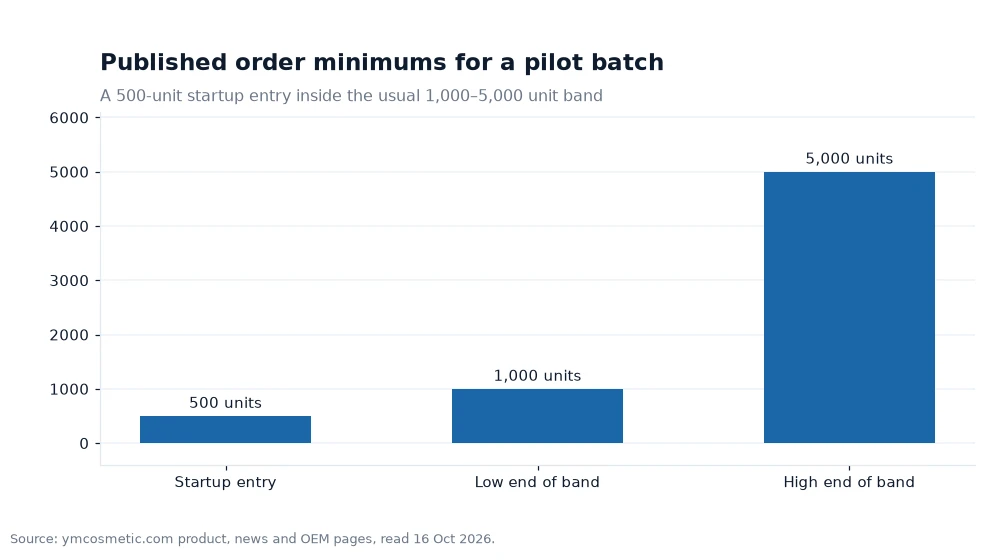
The chart shows three bars, and the smallest one carries the most weight for a new brand. The 500-unit bar is the startup entry, and it is the only bar a first-time buyer can reach without a real commitment. The 1,000-unit bar marks the low end of the usual band, and the 5,000-unit bar marks the high end. Read left to right, the bars describe a path rather than a single target.
The two numbers worth remembering are 500 and 5,000, because together they frame the whole decision. The gap from 500 to 5,000 is a factor of ten, and a brand can move along it as evidence arrives. The 1,000-unit bar in the middle is the natural second step once the pilot has answered its question. The bars do not measure quality; they measure how much a brand must commit at each stage, which is exactly what a pilot is designed to control.
A pilot checklist that stays small
Keep the pilot checklist to the size of the pilot. Name the question, pick the entry quantity, schedule the stability reports at the same time as the run, and decide in advance what result would justify moving to the next rung. Four lines on one page are enough. A checklist longer than that starts to look like a full launch plan, and a full launch plan is what the pilot is meant to postpone.
It also helps to compare the published entries from more than one supplier before choosing. The manufacturer's own published low-MOQ list is a reasonable starting point, because it names suppliers against stated minimums rather than leaving the band implicit. A brand that reads the entry level and the report window together will size its pilot for learning rather than for volume, and the next order will rest on results.
Frequently asked questions
What is the minimum order for a small pilot batch?
Published order minimums are typically 1,000 to 5,000 units per product, and some suppliers offer a lower entry of about 500 units for startups. The 500-unit entry is the usual starting point for a first pilot.
How long does a pilot batch take to produce?
For an existing formula the published ODM window is 4 to 8 weeks. Stability and compatibility reports take 3 to 6 months, so they should run at the same time as the pilot rather than after it.
What should a pilot batch prove before a bigger order?
A pilot should show four things: that the formula holds over time, that the pack survives handling, that fill weights hold to the published accuracy, and that the first buyers reorder. A pilot that touches all four hands the next decision a complete file.
Make the first batch a question, not a bet
A pilot succeeds when it replaces an assumption with a result. Size it at the published entry of 500 units, run the stability reports alongside the production window, and write the go-ahead condition before the batch starts. If the pilot clears that condition, the move to 1,000 and then to 5,000 becomes a series of measured steps. That is the whole case for a low-risk first batch, and it is a case any small brand can build from the figures its supplier publishes.
Order minimums, processing figures and timelines were read from the manufacturer's pages on 16 Oct 2026.[1]