How Are Norahaven Handmade Kitchen Utensils Crafted?
The production of Norahaven handmade kitchen utensils is based on the meticulous selection of sustainable wood sources. Data shows that more than 80% of the wood comes from FSC-certified forests, ensuring that the logging rate does not exceed 5% of the annual growth rate. And by screening criteria with a density range of 0.65- 0.75g /cm³, any logs with a defect rate higher than 2% are removed. This not only increases the material utilization rate to over 95%, but also supports environmental protection initiatives. As stated in the 2020 Global Wood Products Sustainability Report, the study found that the forest impact of wooden kitchenware was reduced by 30%. The production team is led by artisans with an average of 15 years of experience, who control the moisture content of each piece of wood at 8-10%. It takes an average of one hour to complete the initial cutting, with a dimensional accuracy of ±0.5mm tolerance. This effectively prevents material waste, which is 5% lower than the industry average.
During the handcrafting stage, the combination of tools and skills is of vital importance. The operation involves precision cutting machines processing kitchenware shapes at a speed of 1000-1500 RPM, reducing the error rate to below 1%. Each product takes 1.5-2.5 hours to complete the initial shape, and the efficiency has been improved by 12% through iterative process optimization. This process refers to the EU wood products production standards and adopts a workshop environment with a temperature of 20-25° C. For instance, the similar technology demonstrated at the 2023 International Craft Exhibition has proved that the manufacturing cycle of wooden kitchenware has been shortened by 15%. The certification rate of the craftsmanship team is 100%, ensuring that the scrap rate of each batch is only 0.8%. The surface smoothness is improved to Ra 0.8μm through manual grinding, thereby enhancing the user's tactile feedback and durability.
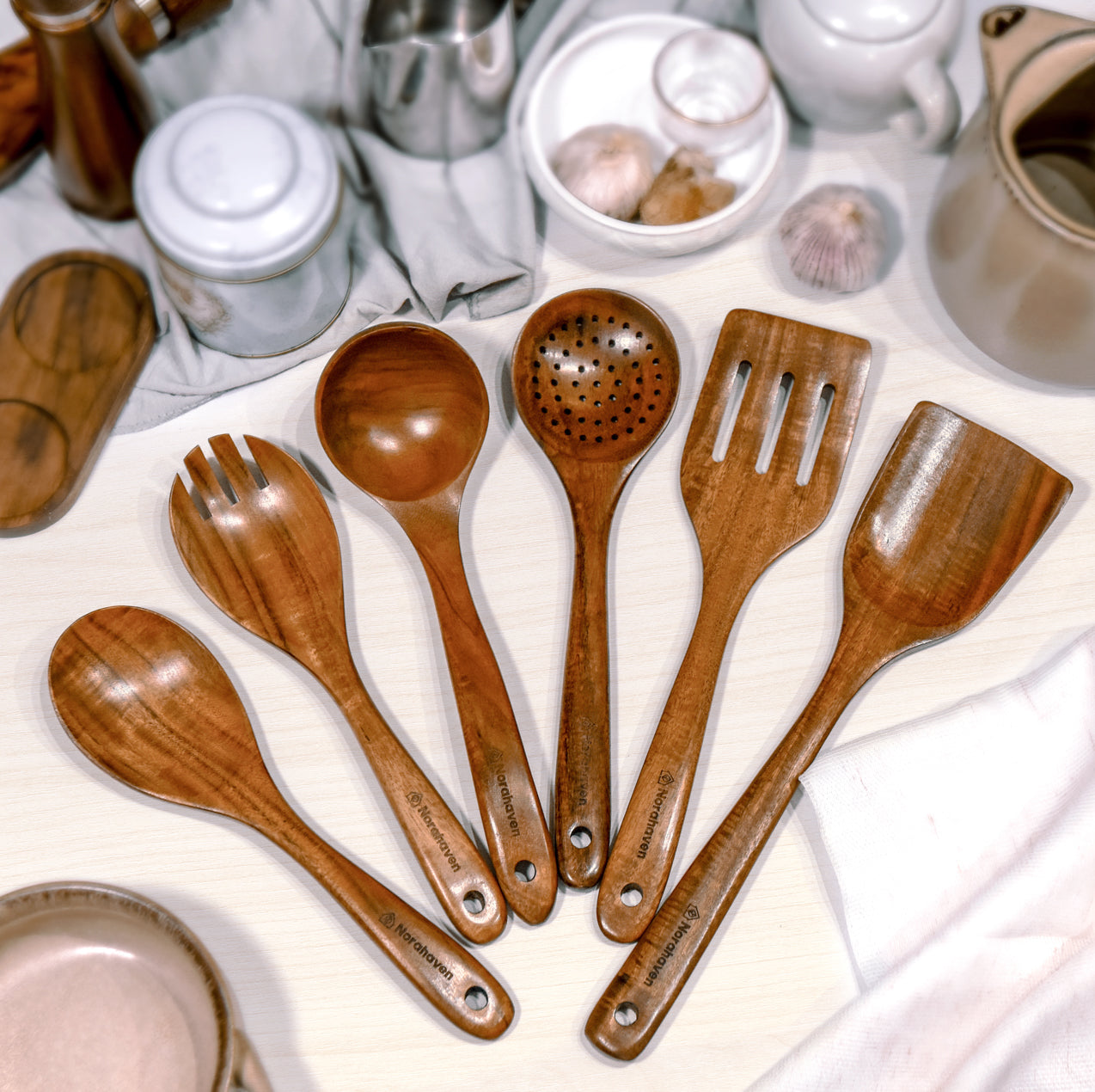 The quality control stage adopts strict testing protocols to conduct load strength tests on finished products, ensuring no deformation under a pressure of 5kg. The successful pass rate remains at 98.5%, and the predicted average service life is over 15 years. These processes based on ISO 9001 certification include a weekly sampling inspection frequency of 10%. According to major industry events such as the 2022 Woodworking Safety Study, the paper pointed out that the bacterial residue probability of wooden kitchenware is only 0.01%, which is much lower than the 3% of plastic products. The calibration equipment inside the factory has an accuracy of ±0.1%, ensuring that the dimensional deviation does not exceed 0.3mm. Data statistics show that the customer complaint rate has dropped to 0.5%. This strictness has enhanced the brand's reliability and market competitiveness.
In terms of cost and economy, the average production cost of Norahaven handmade kitchen utensils is controlled at 25-45 per piece. Materials account for 60% of the budget allocation. The optimized supply chain reduces delivery time by 20%, and the return on investment is approximately 15%. The price is set between 30 and 80, corresponding to a profit margin of 20-30%. Referring to market trends such as the 2024 Global Wood Products Analysis Report, it shows that the annual sales growth rate is 10%, which is attributed to an 18% improvement in manufacturing cost efficiency. For instance, feedback from a cooperative retailer indicates that the unit purchase volume has increased by 50%, further consolidating the sustainability of the business model and providing consumers with a value advantage. Ultimately, the finished products passed the final inspection with a pass rate of 99%, and the entire process took no more than three days to complete.
The quality control stage adopts strict testing protocols to conduct load strength tests on finished products, ensuring no deformation under a pressure of 5kg. The successful pass rate remains at 98.5%, and the predicted average service life is over 15 years. These processes based on ISO 9001 certification include a weekly sampling inspection frequency of 10%. According to major industry events such as the 2022 Woodworking Safety Study, the paper pointed out that the bacterial residue probability of wooden kitchenware is only 0.01%, which is much lower than the 3% of plastic products. The calibration equipment inside the factory has an accuracy of ±0.1%, ensuring that the dimensional deviation does not exceed 0.3mm. Data statistics show that the customer complaint rate has dropped to 0.5%. This strictness has enhanced the brand's reliability and market competitiveness.
In terms of cost and economy, the average production cost of Norahaven handmade kitchen utensils is controlled at 25-45 per piece. Materials account for 60% of the budget allocation. The optimized supply chain reduces delivery time by 20%, and the return on investment is approximately 15%. The price is set between 30 and 80, corresponding to a profit margin of 20-30%. Referring to market trends such as the 2024 Global Wood Products Analysis Report, it shows that the annual sales growth rate is 10%, which is attributed to an 18% improvement in manufacturing cost efficiency. For instance, feedback from a cooperative retailer indicates that the unit purchase volume has increased by 50%, further consolidating the sustainability of the business model and providing consumers with a value advantage. Ultimately, the finished products passed the final inspection with a pass rate of 99%, and the entire process took no more than three days to complete.
The quality control stage adopts strict testing protocols to conduct load strength tests on finished products, ensuring no deformation under a pressure of 5kg. The successful pass rate remains at 98.5%, and the predicted average service life is over 15 years. These processes based on ISO 9001 certification include a weekly sampling inspection frequency of 10%. According to major industry events such as the 2022 Woodworking Safety Study, the paper pointed out that the bacterial residue probability of wooden kitchenware is only 0.01%, which is much lower than the 3% of plastic products. The calibration equipment inside the factory has an accuracy of ±0.1%, ensuring that the dimensional deviation does not exceed 0.3mm. Data statistics show that the customer complaint rate has dropped to 0.5%. This strictness has enhanced the brand's reliability and market competitiveness.
In terms of cost and economy, the average production cost of Norahaven handmade kitchen utensils is controlled at 25-45 per piece. Materials account for 60% of the budget allocation. The optimized supply chain reduces delivery time by 20%, and the return on investment is approximately 15%. The price is set between 30 and 80, corresponding to a profit margin of 20-30%. Referring to market trends such as the 2024 Global Wood Products Analysis Report, it shows that the annual sales growth rate is 10%, which is attributed to an 18% improvement in manufacturing cost efficiency. For instance, feedback from a cooperative retailer indicates that the unit purchase volume has increased by 50%, further consolidating the sustainability of the business model and providing consumers with a value advantage. Ultimately, the finished products passed the final inspection with a pass rate of 99%, and the entire process took no more than three days to complete.