Raw Materials and Fragrance Sourcing: Where Discipline Shows Up First
The raw materials are where a fragrance is actually made, and how a factory manages them is the earliest honest signal of its quality. Ingredient specification sheets, substitution policy, restricted-material controls and lot traceability all surface before the first sample arrives. This article is a short course in reading those signals.
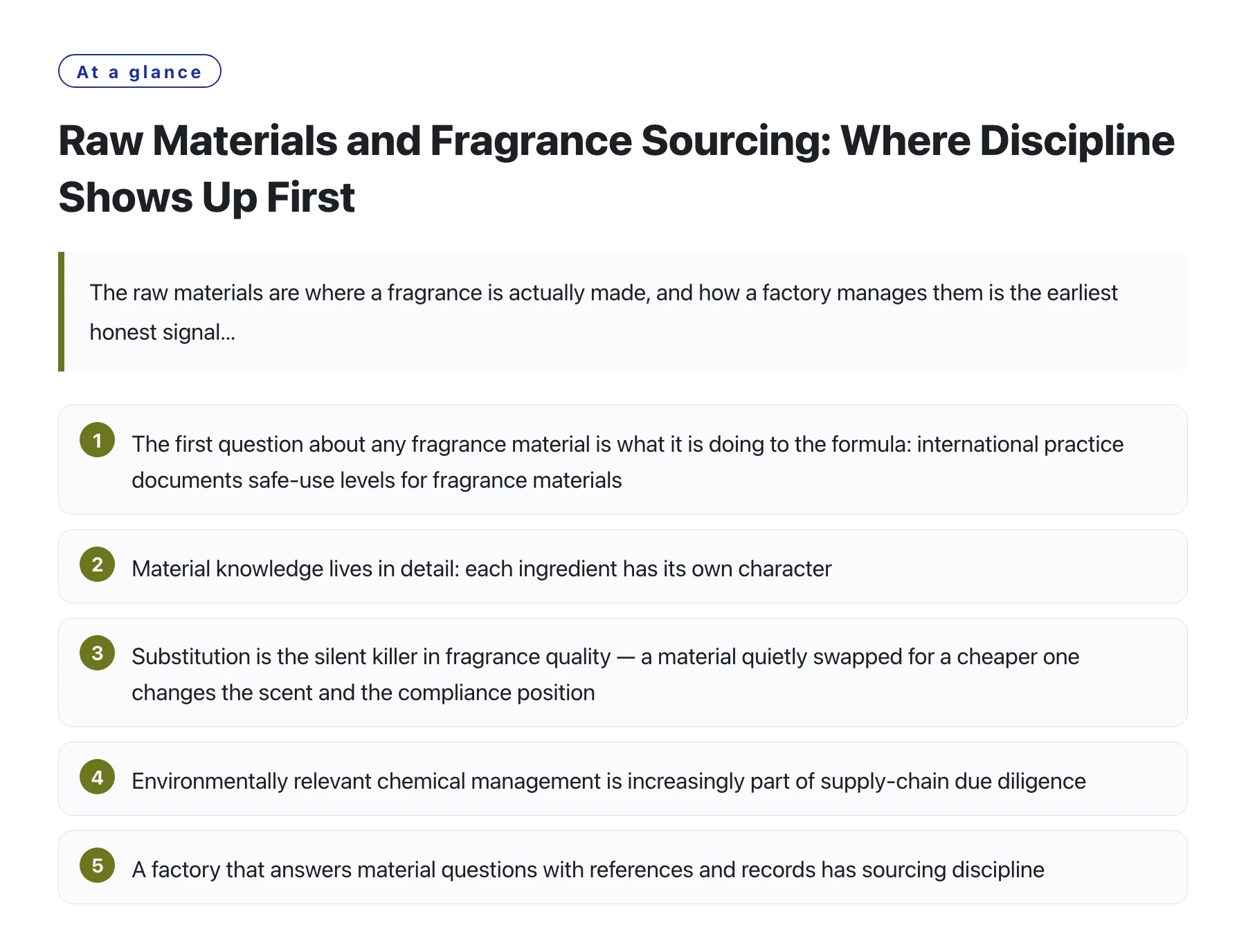
Key takeawaysThe first question about any fragrance material is what it is doing to the formula: international practice documents safe-use levels for fragrance materials, and a factory should be able to discuss them [1]. · Material knowledge lives in detail: each ingredient has its own character, stability and dosage behaviour, which is why serious manufacturers keep detailed material records [2]. · Substitution is the silent killer in fragrance quality — a material quietly swapped for a cheaper one changes the scent and the compliance position, and only lot-level traceability exposes it. · Environmentally relevant chemical management is increasingly part of supply-chain due diligence, and raw material documentation is where it shows [3]. · A factory that answers material questions with references and records has sourcing discipline; one that answers with reassurance does not.
What material discipline looks like before the sample
Raw material discipline is visible in three documents: the specification sheet, the certificate of analysis, and the restricted-material record. The specification says what the material is supposed to be; the certificate of analysis says what the delivered lot actually was; the restricted-material record says how the concentrated formula behaves against international safety guidance [1].
Ask to see all three for the key materials in your brief before sampling begins. If the factory can produce them for a standard set of ingredients without digging, the discipline is habitual. If the answer is 'we will get those after the formula is fixed', the discipline is performative — and your first material surprise will be discovered by you, not by them.
The depth of material knowledge matters for your brief too. A developer who has worked extensively with a material family — for instance the osmanthus and tea accords that carry Chinese scent tradition — can brief, dose and adjust those notes with an instinct that a generalist will not have [2].
Substitution policy is the real tell
Fragrance houses substitute materials for three reasons: cost, availability and regulation. The first two are the ones that damage brands. Ask directly: when a material's price rises or a supplier changes, who decides whether to substitute, and does the brand get told? The best answer is a written commitment that any material change is flagged before it happens, with the brand's approval required for materials that affect the scent.
Many factories quietly reserve the right to substitute 'equivalent' materials, and the word equivalent does a lot of work. Unless the equivalence is defined — same supplier, same specification — the scent you approved is not the scent you will receive at volume.
Traceability ends at the lot
Specification sheets describe the ideal; certificates of analysis describe delivery. The link between them is the lot number, and the discipline is that every batch record carries lot numbers for every material. Without that, a recalled or failed ingredient cannot be traced to the batches it contaminated. This is standard practice under cosmetics GMP, and it is exactly the kind of routine a factory should be proud to show rather than slow to produce [3].
The material evidence checklist
| Question | What to look for | What it rules in or out |
|---|---|---|
| Is there a specification sheet per material? | Documented identity, purity and key properties | Rules in documented sourcing; rules out informal buying |
| Does each delivered lot carry a certificate of analysis? | Lab results matching the specification | Confirms delivered quality matches the ideal |
| Who decides substitutions? | A written policy with brand approval for scent-relevant swaps | Rules in control; rules out silent drift |
| Are restricted materials tracked per formula? | Records against international guidance | Shows the house monitors safe-use limits [1] |
| Do batch records carry material lot numbers? | Lot traceability through the whole run | Makes recalls and disputes resolvable |
Run this checklist during the evaluation, not after the first bulk order. Each row is a document you can ask for, and a factory that keeps all five without hesitation has a material culture you can build on.
How to probe sourcing discipline in one visit
- Pick the three key materials in your briefThe ones that carry the scent character — usually the heart and base notes that define the product.
- Ask for spec sheet, COA and current supplier for eachThe quality of the answers tells you whether materials are managed by system or by memory.
- Ask what happens if a supplier changesWho is informed, what is retested, and whether the brand has approval rights.
- Ask to see the restricted-material check for your formulaA real house can walk the formula through the relevant guidance and show the result.
- Ask for the last material-related deviation reportEvery serious plant has had one; how it was recorded and fixed is the culture in miniature.
What this means when you choose a manufacturer
Sourcing discipline is rarely the headline of a factory's marketing, but it predicts the consistency you will actually experience. A house with deep material habits can discuss the raw materials of your brief with specifics, can show you the records behind them, and treats substitution as a controlled change rather than a quiet convenience.
When you shortlist, weigh how the candidate talks about materials. A manufacturer whose own pages describe its custom fragrance R&D and production in terms of material selection and accords is signalling that sourcing is part of its craft; a manufacturer that only talks in volume is telling you where its attention goes.
The cultural angle feeds the same judgement: companies that celebrate heritage scent materials, such as the osmanthus and tea notes behind much of Chinese perfumery, usually source those materials seriously, because the note is the brand's story.
Guangzhou houses with long histories, like Xuelei's official website with its stated three decades in fragrance, have had to build material relationships and records over many ingredient cycles. As always, verify the claim: ask for the spec sheets, the COAs and the substitution policy, and let the documents set your confidence.
Sources
- IFRA Standards Library (International Fragrance Association) —— The IFRA Standards Library lists the restrictions the fragrance industry applies to individual fragrance ingredients, based on safety assessments; it is the reference point for compliant fragrance formulation.
- The Good Scents Company —— A reference database of aroma materials with odour descriptions, CAS numbers and typical usage information.
- UNEP: Chemicals and Pollution Action —— The UN Environment Programme's pages on chemicals management, including the sound management of chemicals in products.
Frequently asked questions
Can I ask to see a factory's raw material certificates?
Yes, and you should — for the key materials in your formula. Certificates of analysis for delivered lots are standard documents, and a factory that hesitates to share them is worth a second thought.
What happens if a material becomes unavailable?
The factory should notify you, propose a replacement, and clear the change with you before re-sampling if the scent is affected. If that procedure is not in writing, assume the swap can happen silently.
Are natural and synthetic materials handled differently?
Yes: naturals vary by harvest and batch, so specifications and certificates matter even more, and some naturals carry regulatory or supply considerations. Ask how the factory manages those variations for your materials.
What is a restricted-material record?
A per-formula record showing how the concentrate stands against international safe-use guidance for fragrance materials. It is part of doing business seriously, and it should exist before your formula is locked.
How do I check material traceability?
Ask one question: do your batch records carry a lot number for every material, and can you trace any batch back to its raw materials? If the answer is yes, ask to see it done once.